
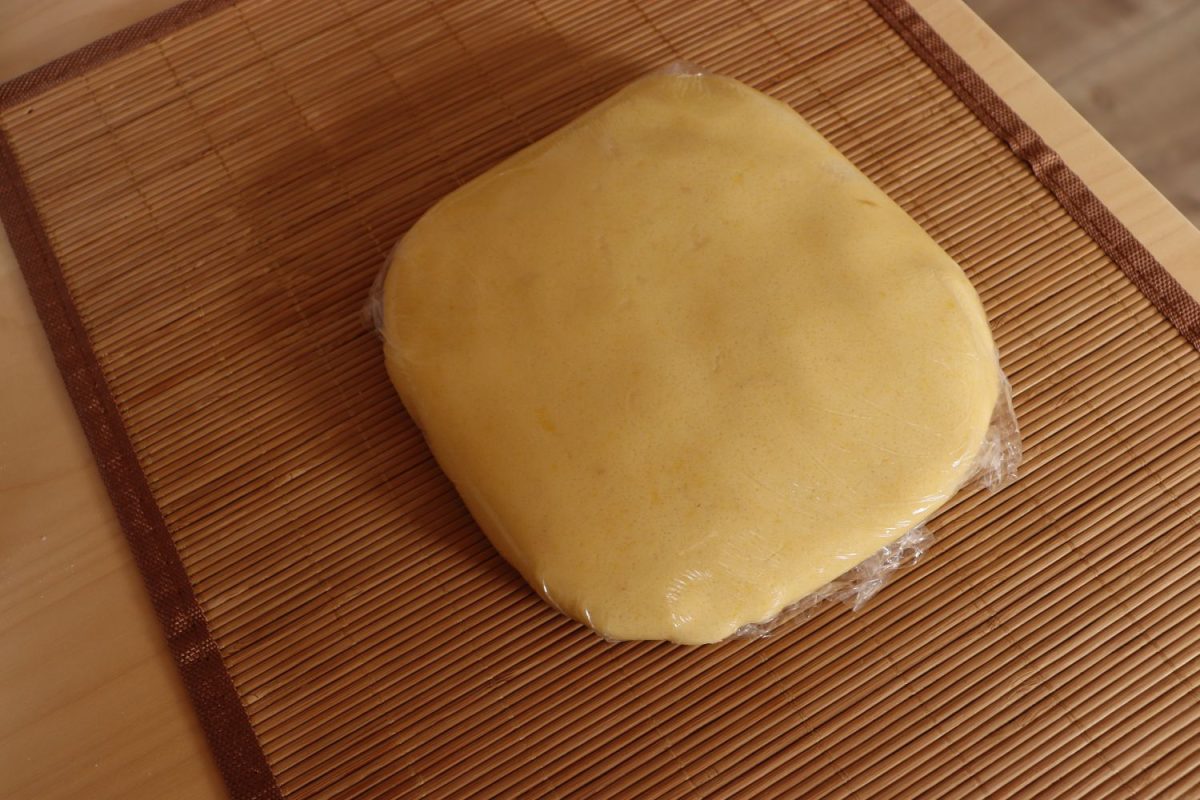
Mürbeteig – German Shortcrust Pastry or Cookie Dough Recipe
3 Ingredients Cookie Dough!
I have recently seen a lot of posts and videos about this and couldn’t help but smile. This super simple recipe is no other than the basic recipe of Mürbeteig: German Shortcrust Pastry. This is a very old recipe and is present in cookbooks and textbooks for learning the bakery and confectionery trades. It’s the basis of all cookies.
Go to Mürbeteig basic recipe (Basic German Shortcrust Pastry Recipe)
Mürbeteig, also called “1-2-3-Teig” (1-2-3-Dough, 1-2-3 Pastry, or 1-2-3 Pie Dough) or butter dough, is a German Shortcrust Pastry used mainly for baking cookies and baked pastry cakes. It gets its name from the proportion of the main ingredients, respectively sugar, fat (usually butter), and flour. To these, salt, vanilla, and lemon peel are usually added. Depending on the region, egg yolk, and, respectively, whole egg may also be added. No water or baking products are needed or allowed.
There’s a controversy going on if eggs should be added to the dough or not. I noticed that in German recipes, people tend to add eggs to the dough because it is easier to work with. In Austrian ones, the tendency is to exclude the egg to get a more crumbly texture.
The main ingredients for Mürbeteig – Sweet German Shortcrust Pastry are 1 part sugar,2 parts fat (usually butter with min. 80% fat), 3 parts cake or all-purpose flour, salt, and flavours of your choice (vanilla, lemon peel). To this, you can also add egg yolk or whole eggs. The best part: you don’t need to knead your dough; you can easily mix the ingredients by hand, so no kitchen appliance is needed. You can use any of the recipes below and bake a lot of delicious cookies. Though most people, when they hear Mürbeteig, understand “1-2-3-Teig“, there are, actually, more types of it, with a slight variation of the proportion of the ingredients.
As an Amazon Associate, I earn from qualifying purchases.
Kindle – check the price on Amazon:

Paperback – Check the price on Amazon:
Types of German Shortcrust Pastry (Mürbeteig):
- Rollable Shortcrust Pastry (ausrollfähiger Mürbeteig):
- This is the classical 1-2-3-Dough (sugar, fat, flour), which people usually expect when they hear “Mürbeteig“.
- It is ideal for rolling out and, therefore, used to make cookies, but also for pie crusts, tarts, and quiches.
- Mürbeteig Formula: 1 part sugar, 2 parts butter, 3 parts flour
- Spritz Cookie Dough (Spritzmürbeteig):
- This type of dough is softer and contains more butter and eggs.
- It is a piping-consistency shortcrust pastry perfect for spritz cookies and decorative piped shapes.
- Spritzmürbeteig Formula: 1 part sugar, 2.5 parts butter, 3 parts flour
- Crumble Topping (Streusel):
- This is a 2-2-3-Dough (sugar, fat, flour).
- It is a shortcrust mixture for making crumbly toppings on cakes, muffins, and fruit desserts.
- Streusel Formula: 2 parts sugar, 2 parts butter, 3 parts flour
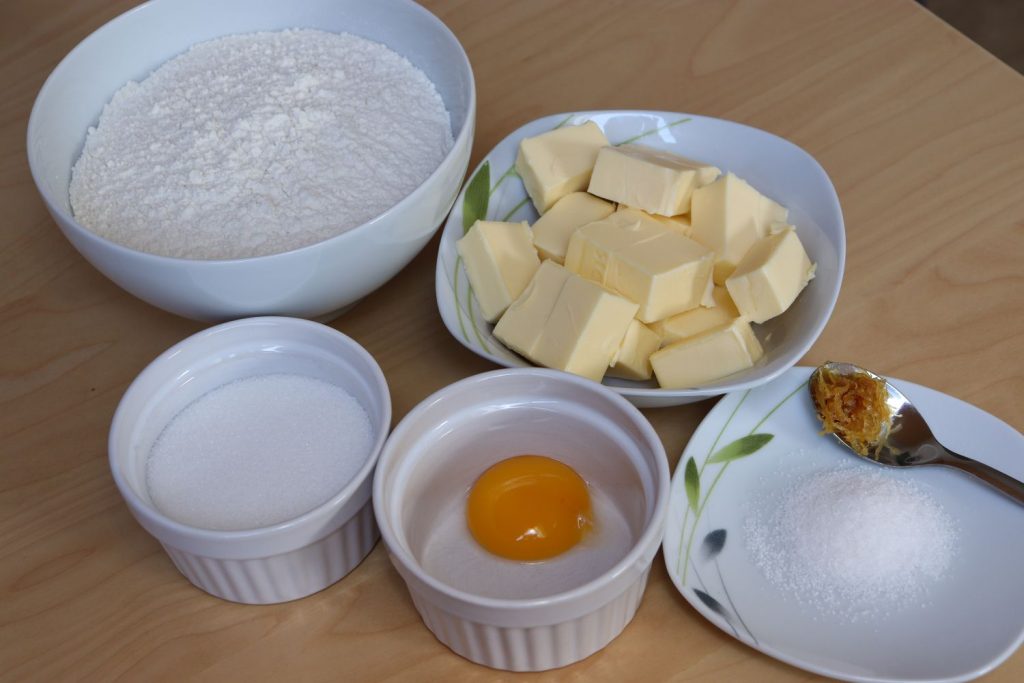
Vanilla Shortcrust Pastry Recipe (Mürbeteig basic recipe):
- 100g caster sugar
- 200g butter
- 300g flour
- 1/4 tsp salt
- 1 sachet vanilla sugar (8g ~ 2tsp) or 1/2 vanilla pod
- 1-2 egg yolks or one whole egg (optional)
- peel of half a lemon (optional)
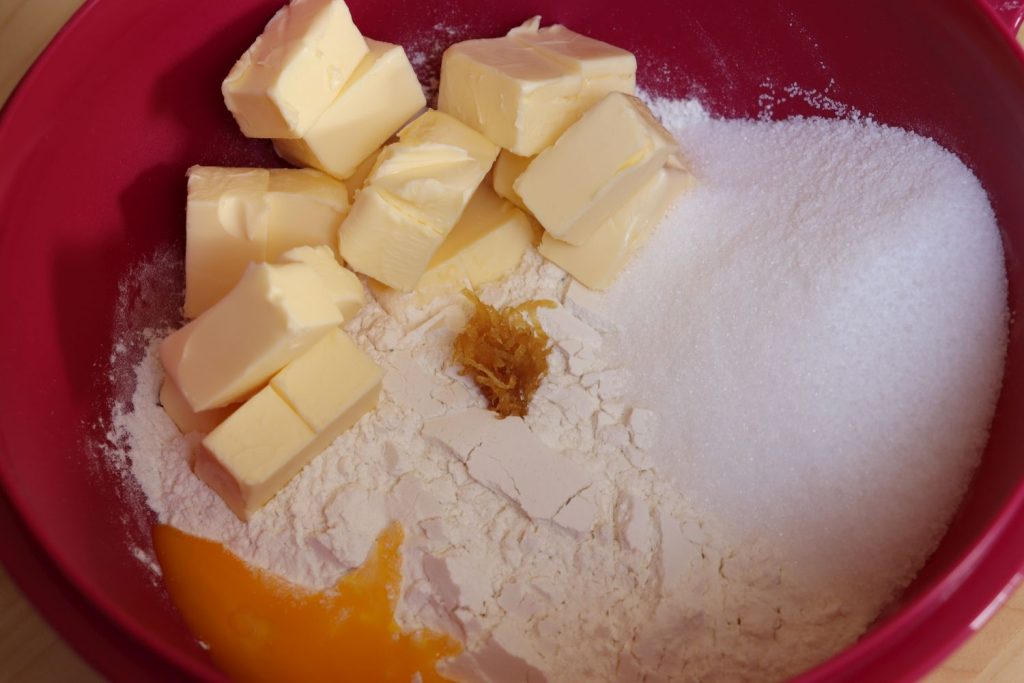
- All ingredients should be cold, especially the butter.
- Mix the dry ingredients: flour, sugar, vanilla sugar, salt, and lemon peel. You can use vanilla bean or vanilla extract if vanilla sugar is not available.
- Add the cold butter cut into cubes, and the egg/egg yolks.
- Mix everything until the ingredients are combined. Do not overmix because the butter will start melting.
- Wrap the dough in foil and keep it in the fridge overnight or for a minimum of 1 hour.
- If you want to use the dough right away, you can use powdered sugar instead of caster sugar. It is however recommended to keep the dough minimum of half an hour in the fridge so that the ingredients properly combine and it’s easier to roll.
Chocolate Shortcrust Pastry Recipe (Schokomürbeteig):
- 100g caster sugar
- 200g butter
- 280g flour
- 1/4 tsp salt
- 30g cocoa (Dutch-processed cocoa powder, which is the standard cocoa type in Europe)
- 1 sachet vanilla sugar (8g ~ 2tsp) or 1/2 vanilla pod
- 1-2 egg yolks or one whole egg (optional)
- peel of half an orange (optional)
- All ingredients should be cold, especially the butter.
- Mix the dry ingredients: flour, cocoa, sugar, vanilla sugar, salt, and orange peel. You can use vanilla bean or vanilla extract if vanilla sugar is not available. Use a sieve for the cocoa since it tends to get clumpy. Orange peel goes very well with cocoa.
- Add the cold butter cut into cubes, and the egg/egg yolks.
- Mix everything until the ingredients are combined. Do not overmix because the butter will start melting.
- Wrap the dough in foil and keep it in the fridge overnight or for a minimum of 1 hour.
- If you want to use the dough right away, you can use powdered sugar instead of caster sugar. It is however, recommended to keep the dough minimum of half an hour in the fridge so that the ingredients properly combine and it’s easier to roll.
Matcha Shortcrust Pastry Recipe (Matchamürbeteig):
- 100g caster sugar
- 200g butter
- 300g flour
- 1 tbsp matcha powder – Japanese green tea (about 5g)
- 1/4 tsp salt
- 1 sachet vanilla sugar (8g ~ 2tsp) or 1/2 vanilla pod
- 1 egg yolk (optional)
- peel of half a lime (optional) – any other citrus also works
- 1 tbsp lime juice (optional) – any other citrus also works
- Matcha goes very well with lime. You can replace it with lemon.
- If you skip the citrus peel and juice, your dough will have a mild bitter taste from the matcha. For most people, pairing it with the sourness of the citrus will give a flavourful dough, with a bit of freshness.
- All ingredients should be cold, especially the butter.
- Mix the dry ingredients: flour, sugar, vanilla sugar, salt, matcha powder, and lime peel. You can use vanilla bean or vanilla extract if vanilla sugar is not available.
- Add the cold butter, cut into cubes, and the egg yolk.
- Mix everything until the ingredients are combined. Do not overmix because the butter will start melting.
- Wrap the dough in foil and keep it in the fridge overnight or for a minimum of 1 hour.
- If you want to use the dough right away, you can use powdered sugar instead of caster sugar. It is however, recommended to keep the dough minimum of half an hour in the fridge so that the ingredients properly combine and it’s easier to roll.
Nut Shortcrust Pastry Recipe (Nussmürbeteig):
- 100g caster sugar
- 200g butter
- 250g flour
- 1/4 tsp salt
- 100g ground nuts (almonds, hazelnuts, walnuts, etc.)
- 1 sachet vanilla sugar (8g ~ 2tsp) or 1/2 vanilla pod
- 1-2 egg yolks or one whole egg (optional)
- peel of half a lemon (optional)
- cinnamon (optional)
- All ingredients should be cold, especially the butter.
- Mix the dry ingredients: flour, ground nuts, sugar, vanilla sugar, salt, lemon peel, and cinnamon. You can use vanilla bean or vanilla extract if vanilla sugar is not available. A pinch of cinnamon goes very well with the nuts in this dough, especially for Christmas cookies.
- Add the cold butter, cut into cubes and the egg/egg yolks.
- Mix everything until the ingredients are combined. Do not overmix because the butter will start melting.
- Wrap the dough in foil and keep it in the fridge overnight or for a minimum of 1 hour.
- If you want to use the dough right away, you can use powdered sugar instead of caster sugar. It is however, recommended to keep the dough minimum of half an hour in the fridge so that the ingredients properly combine and it’s easier to roll.
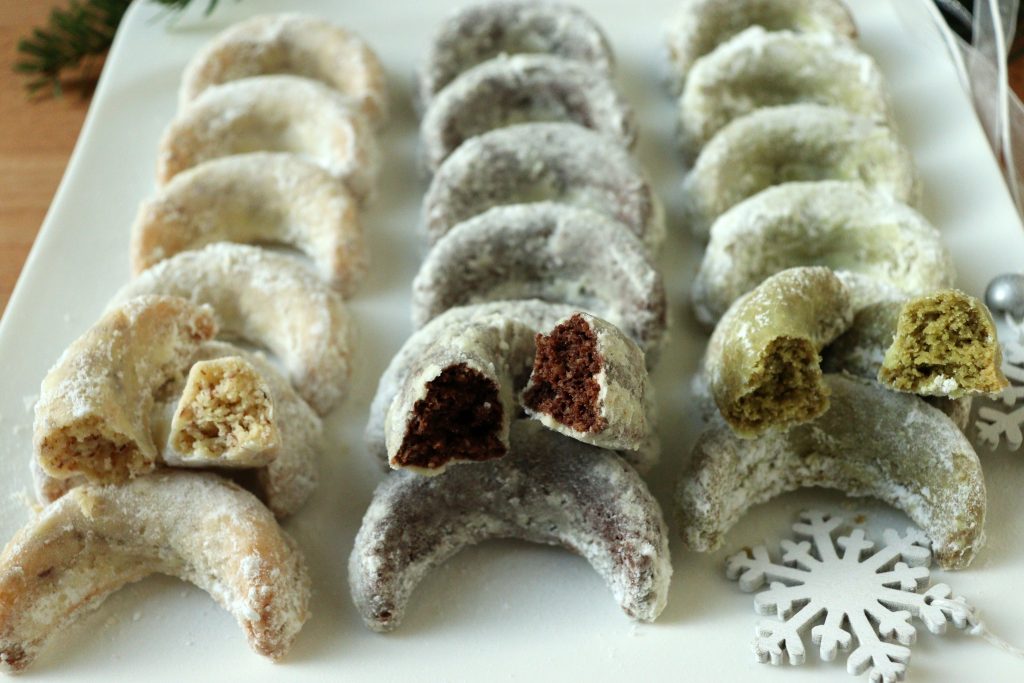
From this Nut Shortcrust Pastry Recipe (Nussmürbeteig) you can make delicious cookies like Vanillekipferl – German Vanilla Crescent Cookies which are typical Christmas Cookies (Weihnachtskekse or Weihnachtsplätzchen) in Germany and Austria.
Matcha Nut Shortcrust Pastry Recipe (Matchanussmürbeteig):
- 100g caster sugar
- 200g butter
- 250g flour
- 1 tbsp matcha powder – Japanese green tea (about 5g)
- 1/4 tsp salt
- 100g ground nuts (almonds, hazelnuts, walnuts, etc.)
- 1 sachet vanilla sugar (8g ~ 2tsp) or 1/2 vanilla pod
- 1 egg yolk (optional)
- peel of half a lime – any other citrus also works
- 1 tbsp lime juice – any other citrus also works
- Matcha goes very well with lime. You can replace it with lemon.
- If you skip the citrus peel and juice, your dough will have a mild bitter taste from the matcha. For most people, pairing it with the sourness of the citrus will give a flavourful dough, with a bit of freshness.
- All ingredients should be cold, especially the butter.
- Mix the dry ingredients: flour, ground nuts, sugar, vanilla sugar, matcha powder, and salt.
- Add the cold butter cut into cubes, lime peel and juice, and the egg yolk.
- Mix everything until the ingredients are combined. Do not overmix because the butter will start melting.
- Wrap the dough in foil and keep it in the fridge overnight or for a minimum of 1 hour.
- If you want to use the dough right away, you can use powdered sugar instead of caster sugar. It is however, recommended to keep the dough minimum of half an hour in the fridge so that the ingredients properly combine and it’s easier to roll.
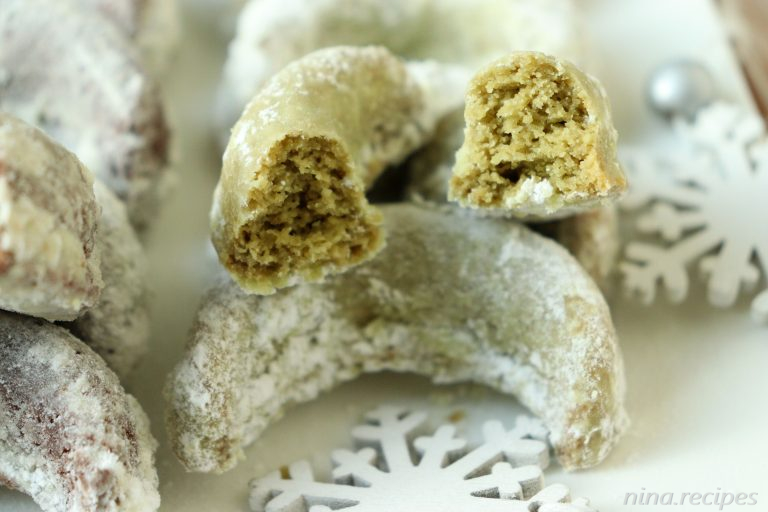
From this Matcha Nut Shortcrust Pastry Recipe (Matchanussmürbeteig) you can make delicious cookies like Matcha Kipferl – German Green Tea Crescent Cookies, a modern interpretation of the traditional Vanillekipferl, with a Japanese inspired touch.
Poppy Seed Shortcrust Pastry Recipe (Mohnmürbeteig):
- 100g caster sugar
- 200g butter
- 250g flour
- 1/4 tsp salt
- 100g ground poppy seeds
- 1 sachet vanilla sugar (8g ~ 2tsp) or 1/2 vanilla pod
- 1 egg yolk (optional)
- peel of half a lemon – any other citrus also works
- 1 tbsp lemon juice – any other citrus also works
- All ingredients should be cold, especially the butter.
- Mix the dry ingredients: flour, ground poppy seeds, sugar, vanilla sugar, salt, and lemon peel. You can use vanilla bean or vanilla extract if vanilla sugar is not available.
- Add the cold butter cut into cubes, the egg yolk, and the lemon peel and juice.
- Mix everything until the ingredients are combined. Do not overmix because the butter will start melting.
- Wrap the dough in foil and keep it in the fridge overnight or for a minimum of 1 hour.
- If you want to use the dough right away, you can use powdered sugar instead of caster sugar. It is, however, recommended to keep the dough minimum of half an hour in the fridge so that the ingredients properly combine and it’s easier to roll.
From this Poppy Seeds Shortcrust Pastry Recipe (Mohnmürbeteig) you can make delicious cookies like Mohnkipferl – German Poppy Seed Crescent Cookies, a great alternative for people with nut allergies.
Coconut Shortcrust Pastry Recipe (Kokosmürbeteig):
- 100g caster sugar
- 200g butter
- 250g flour
- 1/4 tsp salt
- 100g ground coconut
- 1 sachet vanilla sugar (8g ~ 2tsp) or 1/2 vanilla pod
- 1 egg yolk (optional)
- peel of half a lemon – any other citrus also works
- 1 tbsp lemon juice – any other citrus also works
- All ingredients should be cold, especially the butter.
- Mix the dry ingredients: flour, ground coconut, sugar, vanilla sugar, salt, and lemon peel. You can use vanilla bean or vanilla extract if vanilla sugar is not available.
- Add the cold butter cut into cubes, the egg yolk, and the lemon peel and juice.
- Mix everything until the ingredients are combined. Do not overmix because the butter will start melting.
- Wrap the dough in foil and keep it in the fridge overnight or for a minimum of 1 hour.
- If you want to use the dough right away, you can use powdered sugar instead of caster sugar. It is however, recommended to keep the dough minimum of half an hour in the fridge so that the ingredients properly combine and it’s easier to roll.
Despite the fact that the official translation is called “shortcrust”, its wrong. The best analogy is probably “shortbread”, despite the fact that it normally doesnt use any leveling agent, while Mürbeteig can be made with or without it. Also, in the US American language, “shortcrust” is an entirely different type of cake and dough. I’d suggest implementing this into the introduction, as the title is generally misleading without any further information.
Technically speaking, there is no actual equivalent to Mürbeteig in the English language. My guess is, thats because the English bakery process originally was rather unsophisticated, because of the geographical isolation, while in Germany, French, Italian and oriental baking and cuisine had a much larger impact.
cu, w0lf.
Thanks for pointing that out! You’re right that Mürbeteig doesn’t have a perfect one-to-one translation. I use “shortcrust pastry” because it’s the closest equivalent most English-speaking bakers would recognize (so, used for simplicity), though I think that “cookie dough” fits the best.
I agree this can be confusing, so I’ll add a short clarification in the intro to explain the difference better.
Mürbeteig shouldn’t use a leveling agent, so it stays “mürbe (crumbly and soft)”. A leveling agent is used when there’s more moisture in the dough, for example when whole wheat flour and honey is used (honey has water), or other liquid is added (ex.: citrus juice for flavor).
Thanks for pointing that out! You’re right that Mürbeteig doesn’t have a perfect one-to-one translation. I use “shortcrust pastry” because it’s the closest equivalent most English-speaking bakers would recognize (so, used for simplicity), though I think that “cookie dough” fits the best.
I agree this can be confusing, so I’ll add a short clarification in the intro to explain the difference better.
Mürbeteig shouldn’t use a leveling agent, so it stays “mürbe (crumbly and soft)”. A leveling agent is used when there’s more moisture in the dough, for example when whole wheat flour and honey is used, or other liquid is added (ex.: citrus juice for flavor).